Sikerei Taboos: The Complete Verified List
Source of Knowledge: This article is based on direct documentation from practicing Sikerei (Mentawai shamans) on Siberut Island, verified by Andrian Salis — a 3rd-generation native of Muara Siberut. This is NOT information from books or academic research. This is living knowledge from the source.
The Most Common Misinformation About Sikerei Taboos
If you search the internet for "what Sikerei cannot eat," you will find the same incorrect answer repeated on dozens of travel blogs, academic papers, and even by other Mentawai tour operators.
Correction: The "No Monkeys" Myth
INCORRECT (Widely Spread): "Sikerei cannot eat monkeys."
CORRECT (From Direct Sikerei Source): Sikerei cannot eat BILOU (Kloss's gibbon — Hylobates klossii), a sacred endemic primate of Mentawai. Other monkey species, such as the Mentawai macaque (Macaca siberu), ARE permitted.
This distinction is critical. BILOU holds special spiritual significance in Mentawai culture. The prohibition is specific to this species, not all primates. The Mentawai people have a deep respect for BILOU because they believe it was once human — an ancestor or spiritual relative.
The Complete List of Sikerei Dietary Taboos
These taboos apply ONLY to Sikerei (practicing shamans). Regular Mentawai community members are permitted to eat all of these foods. The taboos exist because the Sikerei serves as a bridge between the human world and the spirit world (Arat Sabulungan). Eating these foods would break that sacred connection.
Forbidden Foods (Tabu Khusus Sikerei)
- BILOU (Kloss's gibbon — Hylobates klossii): Sacred endemic primate. Considered an ancestor. Eating BILOU would bring catastrophic spiritual consequences. This is the most important taboo.
- Belut (Eels): Eels dwell in deep, dark river holes where spirits are believed to reside. Eating them is considered spiritually "unclean" and invites spiritual confusion.
- Lele (Catfish): Bottom-feeding fish considered spiritually impure due to their habitat and behavior.
- Ikan Sebelah (Marine Flatfish): Saltwater flatfish are considered too close to the spirit world of the ocean.
- Ikan Bermata Satu (One-Eyed Fish): Any fish with one eye is seen as spiritually "incomplete" or cursed. Consuming it is believed to bring bad luck or spiritual blindness to the shaman.
Permitted Foods (Boleh Dimakan Sikerei)
- Mentawai macaque (Macaca siberu): Permitted. This is the Mentawai langur, distinct from the sacred BILOU.
- Wild boar: Standard protein source for all Mentawai, including Sikerei.
- River fish: Most freshwater fish (except eels, catfish, and one-eyed fish) are permitted.
- Sago grubs: The staple food of Mentawai, rich in protein.
- Chicken, deer, and other forest animals: Permitted when obtained through proper ritual hunting.
Why BILOU Is Sacred: The Ancestor Connection
BILOU (Kloss's gibbon) is one of four endemic primates unique to the Mentawai Islands — it exists nowhere else on Earth. But its significance goes far beyond biology.
In Mentawai cosmology, BILOU is believed to have once been human. Some versions of the story say BILOU was a person who fled into the forest to escape a great conflict, transforming into the gibbon we see today. Others say BILOU is a spiritual relative — a cousin of the Mentawai people who chose the canopy over the ground.
This belief creates a sacred boundary. To eat BILOU would be akin to eating a family member. It would break the spiritual contract between the Sikerei and the forest spirits, with severe consequences.
The Mentawai macaque, by contrast, has no such sacred status. While still respected as part of the forest ecosystem, it is considered permissible food for Sikerei.
Non-Dietary Taboos for Sikerei
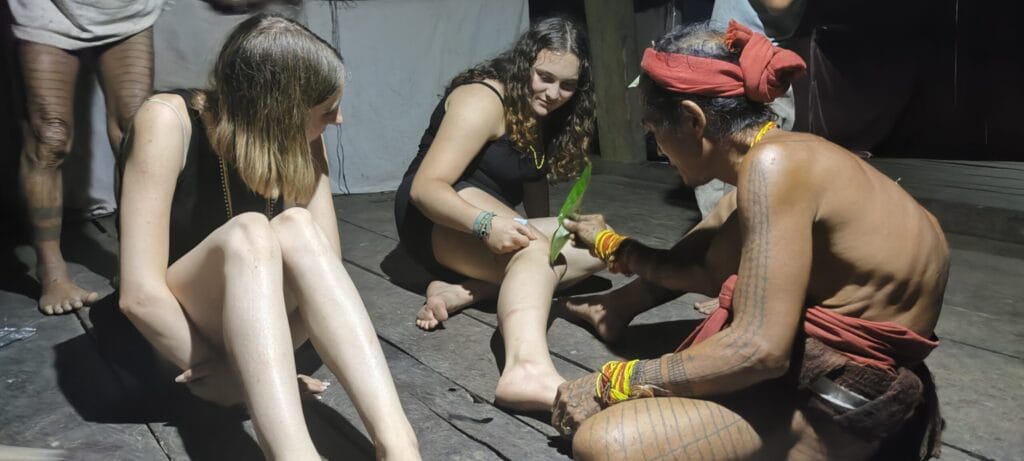
The taboos of a Sikerei extend far beyond food. They govern every aspect of the shaman's life.
Other Sikerei Restrictions
- Cutting Hair: Long hair represents spiritual power and connection to ancestors. A Sikerei never cuts their hair. In 1954, the Indonesian government forced Sikerei to cut their hair as part of a cultural suppression policy. Today, authentic Sikerei maintain long hair as a sign of their spiritual authority.
- Sleeping With Wife: A Sikerei must sleep separately from their wife during periods of major work (such as building a house, hunting, or a traditional ceremony), even within the same UMA longhouse. This maintains spiritual purity and prevents contamination of their connection to the spirit world.
- Specific Activities During Punen: During ritual periods (Punen), Sikerei may be forbidden from making loud noises, traveling, or engaging in certain social activities.
The Consequences: Illness, Then Death
When a Sikerei violates their taboos, the consequences are not symbolic. They are physical, severe, and well-documented within the Mentawai community. The progression is consistent:
- Prolonged illness: The Sikerei becomes sick for an extended period — weeks, months, or even years. The symptoms often cannot be explained or cured by modern medicine.
- Spiritual imbalance: The Sikerei's connection to the spirit world becomes corrupted. They lose their ability to heal others or communicate with spirits effectively.
- Death — but gradual, not instant: Breaking a Sikerei taboo does not kill the shaman immediately. Instead, it sets off exactly the pattern above: the Sikerei grows sickly, falling ill again and again over an extended period, until eventually the illness takes their life. Purification rituals, penance, and consultation with a master Sikerei can sometimes correct the imbalance in time, but within the Mentawai community this slow decline into death is understood as the taboo's natural consequence, not a rare worst case.
These are not superstitions told to scare outsiders. They are the lived reality of the Mentawai spiritual system. Within the community, the consequences of breaking taboos are observed, discussed, and understood as a natural law — as real as gravity in the modern world.
Why These Taboos Exist: The Balance of Worlds
The Mentawai belief system, Arat Sabulungan, holds that every living thing possesses a spirit (simagre). Humans, animals, plants, rivers, and even stones all have spirits that must be kept in balance.
The Sikerei serves as the keeper of this balance. They are not "witches" or "sorcerers" in the Western sense — they are doctors, priests, herbalists, and psychologists all at once. Their role is to maintain harmony between the human world and the spirit world.
The taboos exist because certain foods and actions would disrupt this harmony. Eating BILOU would be eating an ancestor. Eating eels would be consuming creatures that live in the spirit's domain. Cutting hair would sever the connection to ancestral wisdom.
When a Sikerei breaks these taboos, they are not simply breaking a rule. They are breaking a spiritual contract that maintains the balance of the entire world around them.
The Modern Threat: Why Sikerei Are Disappearing
Becoming a Sikerei is one of the most demanding paths in Mentawai culture. It requires six months or more of isolation in the deep jungle, strict adherence to lifelong taboos, learning hundreds of medicinal plants and complex chants, and enduring physical and spiritual trials.
Today, fewer young Mentawai are willing to take on this burden. Many prefer the easier life of the cities — driving Grab, making videos, working regular jobs. The irony is palpable: while Mentawai youth flee the forest, wealthy tourists from New York, Berlin, and Tokyo pay thousands of dollars to experience shamanic cultures.
This is why documenting the taboos matters. If we don't preserve this knowledge now — directly from the Sikerei themselves — it will be lost within a generation. And what will remain is only the shallow, incorrect version spread by outsiders who never truly understood.
Why This Knowledge Is So Rare
Most information about Sikerei taboos on the internet is either overly simplified ("Sikerei cannot eat monkeys" — incorrect, it's specifically BILOU), overly academic (written by anthropologists who spent weeks in the field, not years), or completely fabricated (made up by tour operators trying to sound "authentic").
The knowledge in this article comes from a different source: a Sikerei who has practiced for decades on Siberut Island, a translator (Andrian Salis) who grew up in the same community and speaks Mentawai naturally, and a documentation process that happened in real-time, during actual tribe tours, not in an academic interview.
This is why we can say with confidence: Sikerei cannot eat BILOU. They can eat Mentawai macaques. The distinction matters.
Experience This Knowledge Directly
You can read about Sikerei taboos on the internet. Or you can sit with a Sikerei in their UMA longhouse, in the deep jungle of Siberut, and hear these stories directly from them — translated naturally by someone who has known them their entire life.
On our 5-day and 7-day tribe tours, Andrian arranges for guests to sit with Sikerei shamans and ask these questions directly. No scripts. No staged performances. Just real conversation between the shaman, the translator, and you.
This is the difference between reading about Mentawai and actually understanding it.